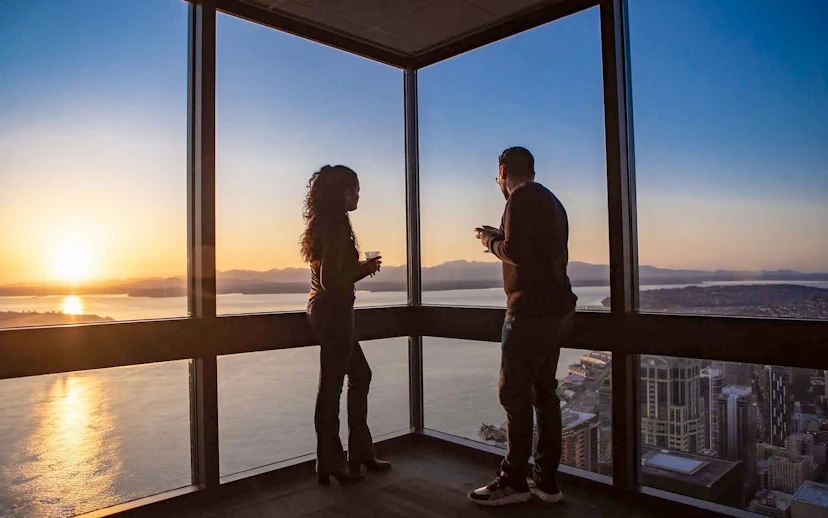
Plan your visit to Sky View Observatory
Sky View Observatory is Seattle’s highest public observation deck, best known for its full 360° views from the 73rd floor of Columbia Center. The visit itself is straightforward, but the experience changes a lot depending on the weather, light, and what time slot you book. On clear days, you’ll want to pace your loop around the windows instead of stopping at the first skyline view. This guide covers timing, entry, route, and the details that make the visit smoother.
Quick overview
If you only read one section before booking, make it this one.
- When to visit: Daily, with hours that vary by season and date. Weekday late mornings and early afternoons are noticeably calmer than clear-sky sunset slots, because sunset brings both photo crowds and more demand for window seating at the café.
- Getting in: From $27 for standard entry. You can buy on the day, but clear-weather sunset slots are the ones most worth booking ahead.
- How long to allow: 1–1.5 hours for most visitors. It pushes closer to 2 hours if you stay for a drink, wait for sunset, or circle the deck more than once for photos.
- What most people miss: The south-facing Mt. Rainier view, the interactive landmark panels, and how much better the west-facing waterfront side looks once the ferries start moving below you.
Jump to what you need
🕒 Where and when to go
🗓️ How much time do you need?
🗺️ Getting around
🌆 What to see
♿ Facilities and accessibility
Where and when to go

How do you get to Sky View Observatory?
Sky View Observatory is in downtown Seattle’s financial district, inside Columbia Center, about a 10–15 minute walk from Pike Place Market and close to the main downtown transit corridor.
Address: 700 4th Ave, Seattle, WA 98104, United States | Find on Maps
- Light rail: University Street Station → 10–12 minute walk → Best if you’re coming from Seattle-Tacoma International Airport or central downtown.
- Bus: 3rd Ave downtown corridor stops → 3–5 minute walk → The easiest option if you’re already moving around central Seattle by transit.
- Taxi/rideshare: Columbia Center entrance on 4th Ave → 1–2 minute walk → Best for direct drop-off without downtown parking hassle.
- Walking: From Pike Place Market → 10–15 minutes → Mostly straightforward downhill and flat city blocks.

Which entrance should you use?
There’s one public entry point through the Columbia Center, and the main thing visitors get wrong is assuming they can head straight upstairs without checking in first.
- Main public entrance: Located at 700 4th Ave lobby level. Best for all ticket holders. Expect 5–10 minutes at busy sunset windows.

When is Sky View Observatory open?
- Daily schedule: The observatory opens at 12pm in noon and closes at 7pm.
- Last elevator: 1 hour before closing.
- Sky View Café & Bar: Closes 30 minutes before the observatory.
When is it busiest? Clear Friday–Sunday evenings, summer weekends, and the hour before sunset are the busiest, which matters most if you want unobstructed photo windows or café seating.
When should you actually go? Book a weekday late-morning or early-afternoon slot on a clear day if you want the same views with more space to move and shorter elevator waits.
How do you get around Sky View Observatory?

Observation deck layout
Sky View is a compact indoor observation deck, so you can cover the full public area comfortably on foot in under an hour. The layout is easy to self-navigate, but it’s still worth doing one full loop before you settle at a favorite window.
- South-facing side: Mt. Rainier and south Seattle skyline → 10–15 minutes.
- West-facing side: Elliott Bay, ferries, the waterfront, and the Great Wheel → 10 minutes.
- North-facing side: Space Needle, downtown towers, and South Lake Union → 10–15 minutes.
- East-facing side: Bellevue, Lake Washington corridor, and the Cascades on clear days → 10 minutes.
Suggested route: Start on the south-facing windows if the weather is clear, then move west for waterfront views, north for the Space Needle, and finish east; most visitors do the reverse and miss the clearest Rainier view while the deck is still relatively empty.

Maps and navigation tools
- Map: On-deck digital panels and interactive displays label the skyline and mountain views → use them once you’ve done one full loop.
- Signage: Wayfinding is good enough for a self-guided visit → you don’t need a downloaded map for a deck this compact.
- Audio guide / app: There isn’t a separate Audioguide mentioned for the public visit → the short elevator multimedia and viewing panels do most of the interpretation.
💡 Pro tip: Do one full lap before you start taking serious photos; the first window you reach is rarely the best one for the clearest light or least glare.
What can you see from Sky View Observatory?
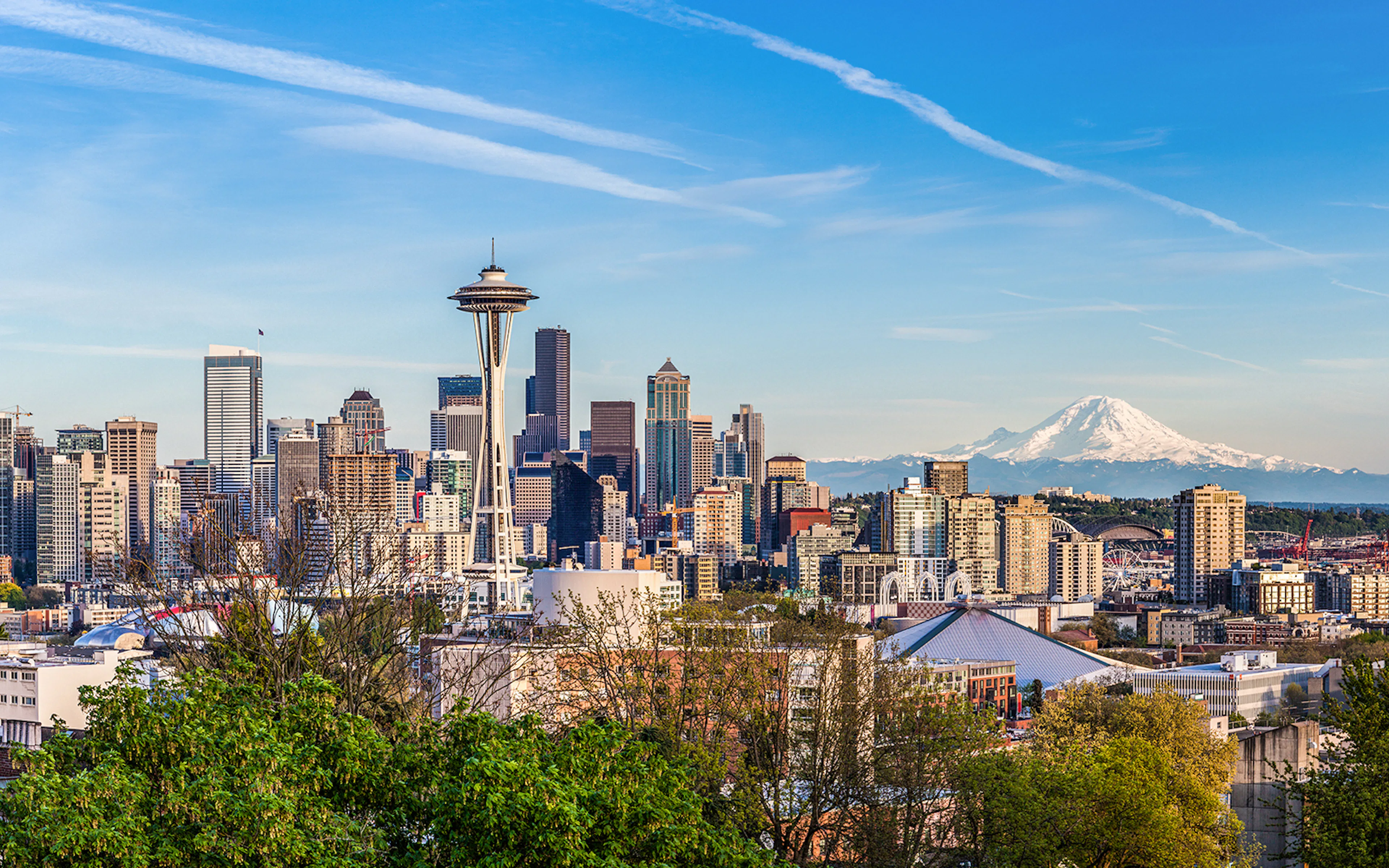
Mt. Rainier
View type: Mountain panorama
On a clear day, this is the view that justifies coming here over almost anywhere else in Seattle. Mt. Rainier sits dramatically to the south, and because you’re so high above the city, it feels less like a distant backdrop and more like the anchor of the whole landscape. Most visitors rush north for the Space Needle first and only circle back later, when glare or crowding is worse.
Where to find it: South-facing windows after you step out onto the main deck loop.
Space Needle and north skyline
View type: Landmark and city skyline
This is the classic ‘Seattle from above’ shot: the Space Needle rising beyond the downtown towers, with South Lake Union stretching behind it. It’s one of the easiest views to recognize, which is why it gets crowded fast, especially at sunset. What most people miss is how much stronger the composition looks once you include the surrounding skyline instead of isolating the Needle on its own.
Where to find it: North-facing windows on the main public deck.
Elliott Bay and the waterfront
View type: Waterfront panorama
The west-facing side gives you moving scenery rather than a static skyline, ferries, piers, the Great Wheel, and the full waterfront edge. It’s especially good if you want a sense of how Seattle actually works as a port city, not just how it photographs. Many visitors give this side too little time, even though the ferry movement below often makes for the liveliest photos.
Where to find it: West-facing windows overlooking the waterfront and bay.
Olympic Mountains and Puget Sound
View type: Long-distance landscape
When visibility is strong, this side opens up well beyond the city and reminds you how much water and mountain geography shape Seattle. The Olympic range sits far enough away that people sometimes mistake it for cloud cover and move on too quickly. Slow down here for a minute, this is one of the views that feels biggest in person, not in photos.
Where to find it: West to north-west-facing windows, beyond the Elliott Bay view.
Bellevue and the eastern skyline
View type: Urban and regional view
The east side is easy to overlook because it feels less iconic at first glance, but it gives you a much better read on Greater Seattle beyond the tourist core. You can trace the city’s expansion toward Bellevue and the lake corridor, and on clear days the distant foothills add depth that many visitors miss. This is also one of the calmer sides of the deck once sunset crowds build.
Where to find it: East-facing windows opposite the waterfront side.
Facilities and accessibility
- 🎒 Bag policy: Large luggage isn’t allowed, so keep what you bring compact enough for a short indoor visit.
- 🚻 Restrooms: Restrooms are available on the 73rd floor, and there is an additional restroom one floor below.
- 🍽️ Sky View Café & Bar: The on-site café serves snacks, flatbreads, salads, beer, wine, and cocktails, and it closes 30 minutes before the observatory.
- 🛍️ Gift shop/merchandise: A gift shop is available, and ticket add-ons can include discount vouchers to use there.
- 🪑 Seating/rest areas: The main seating is tied to the café area, and reserved window seating is available on some ticket options.
- 🛗 Elevators: High-speed elevators are part of the visit and get you from street level to the 73rd floor in about 70 seconds.
- ♿ Mobility: The observatory is wheelchair-accessible, with elevator access up to the 73rd floor and accessible restrooms available in the building.
- 👁️ Visual impairments: Service animals are allowed, which matters if you’re visiting with a guide dog or other trained support animal.
- 🧠 Cognitive and sensory needs: Clear weekday daytime slots are the calmest choice, while the hour before sunset is usually the loudest and most crowded part of the day.
- 👨👩👧 Families and strollers: Prams and strollers are allowed, and the visit is compact enough that you don’t need to fold a stroller for the main route.
Sky View works well for children who enjoy big views, spotting landmarks, and short city outings rather than hands-on exhibits.
- 🕐 Time: Around 45–60 minutes is realistic with young children, and the north and west-facing windows usually hold their attention best.
- 🏠 Facilities: Restrooms, elevators, stroller access, and the café make it easier than a longer museum or outdoor attraction.
- 💡 Engagement: Turn the visit into a spotting game by having kids find the Space Needle, ferries, and the Great Wheel before you move to the next side.
- 🎒 Logistics: Bring a light layer and keep bags small, because large luggage isn’t allowed and sunset slots are harder to manage with tired kids.
- 📍 After your visit: The Seattle waterfront is a good next stop if you want something active after a mostly stationary viewpoint visit.
Rules and restrictions

What you need to know before you go
- Entry requirement: Your ticket is timed and date-specific, so arrive with your booking ready to scan and don’t treat it like open-ended admission.
- Bag policy: Outside luggage isn’t allowed, which is a bigger issue here than at street-level attractions because there’s no point carrying extra weight into a compact indoor deck.
- Arrival timing: Aim to get there 5–10 minutes before your slot, especially around sunset when elevator demand builds.

Not allowed
- 🚫 Food and drink: Outside food and beverages aren’t allowed, so plan to use the on-site café if you want a drink or snack upstairs.
- 🚬 Smoking and vaping: Smoking and vaping aren’t allowed anywhere inside the observatory.
- 🐾 Pets: Pets aren’t allowed, but service animals are permitted.
- 🧳 Luggage: Suitcases and large bags aren’t allowed, so don’t come straight from the airport or a hotel checkout with full-size baggage.

Photography
Personal photography is one of the main reasons to visit, and you can take skyline, waterfront, and mountain photos throughout the public viewing deck. Keep your setup compact and handheld; this is a shared indoor space designed for movement around the windows, not for bulky gear or anything that blocks sightlines. If part of the floor is reserved for an event, follow staff direction and shoot from the open public areas.

Good to know
- Cashless venue: Cash isn’t accepted as payment, so bring a card or mobile payment method if you want anything from the café or gift shop.
- Café timing: The café closes 30 minutes before the observatory, which catches people out if they plan to order once the sunset colors have already started.
Practical tips
- Booking and arrival: Book your clear-day sunset slot before the day of your visit if that timing matters to you, and arrive 5–10 minutes early so you’re not joining the busiest elevator wave.
- Pacing: Don’t camp at the first skyline view you see; do one quick lap, note where the glare is lowest, and then come back for your best photos.
- Crowd management: Weekday late mornings and early afternoons are your sweet spot here, because you get the same elevation and landmark views without the heavier sunset rush.
- What to bring or leave behind: Bring a small bag, a charged phone or camera, and a payment card; leave luggage elsewhere, because large bags aren’t allowed, and cash won’t help you upstairs.
- Food and drink: If you want to eat or have a drink on the 73rd floor, order earlier than you think. The café closes 30 minutes before the observatory, and window seats get harder to find as sunset approaches.
- Weather strategy: Treat this as a clear-day attraction if the mountain view matters most to you; Seattle’s skyline still works in cloud, but Rainier and the Olympic range are the first things you lose.
What else is worth visiting nearby?

Argosy Harbor Cruise
Distance: 1.3km - 15-minute walk
Why people combine them: You get Seattle from two opposite perspectives in one half-day, first from 902 feet up, then from the waterline below the skyline.
✨ Sky View Observatory and Argosy Harbor Cruise are most commonly visited together, and simplest to do on a combo ticket. The pairing saves you from planning two separate downtown sightseeing windows and gives you Seattle from above and at sea level in the same day.

Pike Place Market
Distance: 1km - 12-minute walk
Why people combine them: It’s an easy same-day pairing because Pike Place gives you Seattle’s street-level energy, food, and waterfront edge right after a short, self-contained visit above the city.

Also nearby
Seattle Great Wheel
Distance: 1.2km - 15-minute walk
Worth knowing: It gives you a much lower, waterfront-facing perspective than Sky View, so it works better as a contrast stop than a substitute.
Bainbridge Island ferry terminal
Distance: 1.6km - 20-minute walk
Worth knowing: If you want one of Seattle’s best skyline views after leaving the observatory, the ferry ride gives you the city from the water with almost no planning.
Eat, shop and stay near Sky View Observatory
- On-site: Sky View Café & Bar serves snacks, flatbreads, salads, beer, wine, and cocktails, and it’s worth it more for the view than for a full meal.
- Grand Central Bakery (6-minute walk, 626 3rd Ave, Seattle, WA 98104): Casual bakery-café with good coffee, sandwiches, and pastries if you want an easy pre-visit breakfast or lunch.
- Tat’s Delicatessen (7-minute walk, 159 Yesler Way, Seattle, WA 98104): Big deli sandwiches and quick counter service make this the most practical nearby stop if you want something filling without losing much time.
- Metropolitan Grill (10-minute walk, 820 2nd Ave, Seattle, WA 98104): A classic downtown steakhouse that works better after your visit if you’re turning the observatory into a date-night plan.
- 💡 Pro tip: If you want both café time upstairs and a proper meal later, use the observatory for drinks and views first, then eat on the ground. Sunset is the worst time to rely on getting a good window table and lingering over food.
- Sky View gift shop: Located at the observatory and best for skyline souvenirs, postcards, and easy one-stop gifts tied directly to the visit.
- Pike Place Market (12-minute walk, 85 Pike St, Seattle, WA 98101): Best for Seattle-made food gifts, small local crafts, and something less generic than observation-deck merch.
- Westlake Center (18-minute walk, 400 Pine St, Seattle, WA 98101): Useful if you want mainstream retail before catching the Link light rail or the Monorail.
Downtown around the Columbia Center is convenient if you want a short Seattle trip with minimal transit and easy access to major sights. It’s more practical than charming, though, so it works best for visitors who care more about walkability than neighborhood personality. If you want nightlife, waterfront atmosphere, or a more local feel, this isn’t the strongest base in the city.
- Price point: Mostly mid-range to higher-end downtown hotels, with business-travel pricing patterns that can jump on weekdays.
- Best for: Short stays where you want to walk to Pike Place Market, the waterfront, transit, and the observatory without planning much.
- Consider instead: Belltown suits longer stays if you want more restaurants and nightlife, while Pioneer Square works better if you want more character and easier stadium or ferry access.
Frequently asked questions about visiting Sky View Observatory
Most visits take 1–1.5 hours. That’s enough time for the elevator ride, one full loop around the 360° deck, photos from multiple windows, and a few minutes with the landmark panels. If you book around sunset or plan to sit at the café, you could easily stay closer to 2 hours.
No, you don’t always need to book in advance, but it’s smart for clear-weather sunset slots. Those are the most in-demand times because you get daylight, golden hour, and city lights in one visit. Daytime weekday slots are much easier to buy closer to the time.
Arrive 5–10 minutes before your timed entry. That gives you enough time to find the lobby, scan your ticket, and join the elevator line without feeling rushed. Sunset is the one time of day when even a short delay can mean a busier ride up and fewer free windows when you arrive.
Yes, you can bring a small bag or backpack, but not luggage or oversized bags. This is a compact indoor observation deck, so large baggage is more of a problem here than at bigger attractions. If you’re coming from the airport or after hotel checkout, store your luggage before you go.
Yes, personal photography is a central part of the experience. The main deck is built around large windows and panoramic views, so you can take skyline, mountain, and waterfront shots from every side. Compact, handheld gear works best because the public viewing areas are shared and busiest around sunset.
Yes, you can visit with a group, and group bookings are available for 10 or more people. That works well for school groups, company outings, or family gatherings because the visit is short, weather-dependent, and easy to fit into a broader Seattle itinerary. Private event options also exist for special occasions.
Yes, it’s a good family stop if your children enjoy views, spotting landmarks, and short visits. The experience is stroller-friendly, fully indoors, and usually done in under 90 minutes, which makes it easier than a longer museum day. It works best when you treat it as a focused outing, not a full afternoon activity.
Yes, Sky View Observatory is wheelchair-accessible. Elevator access takes you directly to the 73rd floor, and the public deck is set up for smooth movement rather than stairs or split levels. Service animals are also allowed, which helps if you’re visiting with a trained assistance animal.
Yes, food is available both on-site and nearby. Sky View Café & Bar serves drinks, snacks, and light meals on the observation level, while downtown options like bakeries, delis, and steakhouses are all within a 5–10 minute walk. The one timing catch is that the café closes 30 minutes before the observatory.
The best time is a clear weekday late morning or early afternoon if you care most about space and visibility. Sunset is the most atmospheric time, but it’s also the busiest, which means more people at the windows and more competition for café seating. If mountain views matter most, prioritize weather over time of day.
Cloud doesn’t ruin the visit, but it changes what makes it worth doing. You’ll still get strong downtown and waterfront views, but Mt. Rainier, the Olympics, and the longer mountain lines are the first things to disappear. If those are the main reason you’re going, pick the clearest day of your trip rather than treating this as a fixed-plan attraction.
Headout tickets include entry to Sky View Observatory in Seattle. Depending on the option you choose, your booking can also include discount vouchers for the Sky View Café and gift shop or reserved window seating. It’s a good fit if you want a simple, self-paced visit without sorting through multiple separate products.